

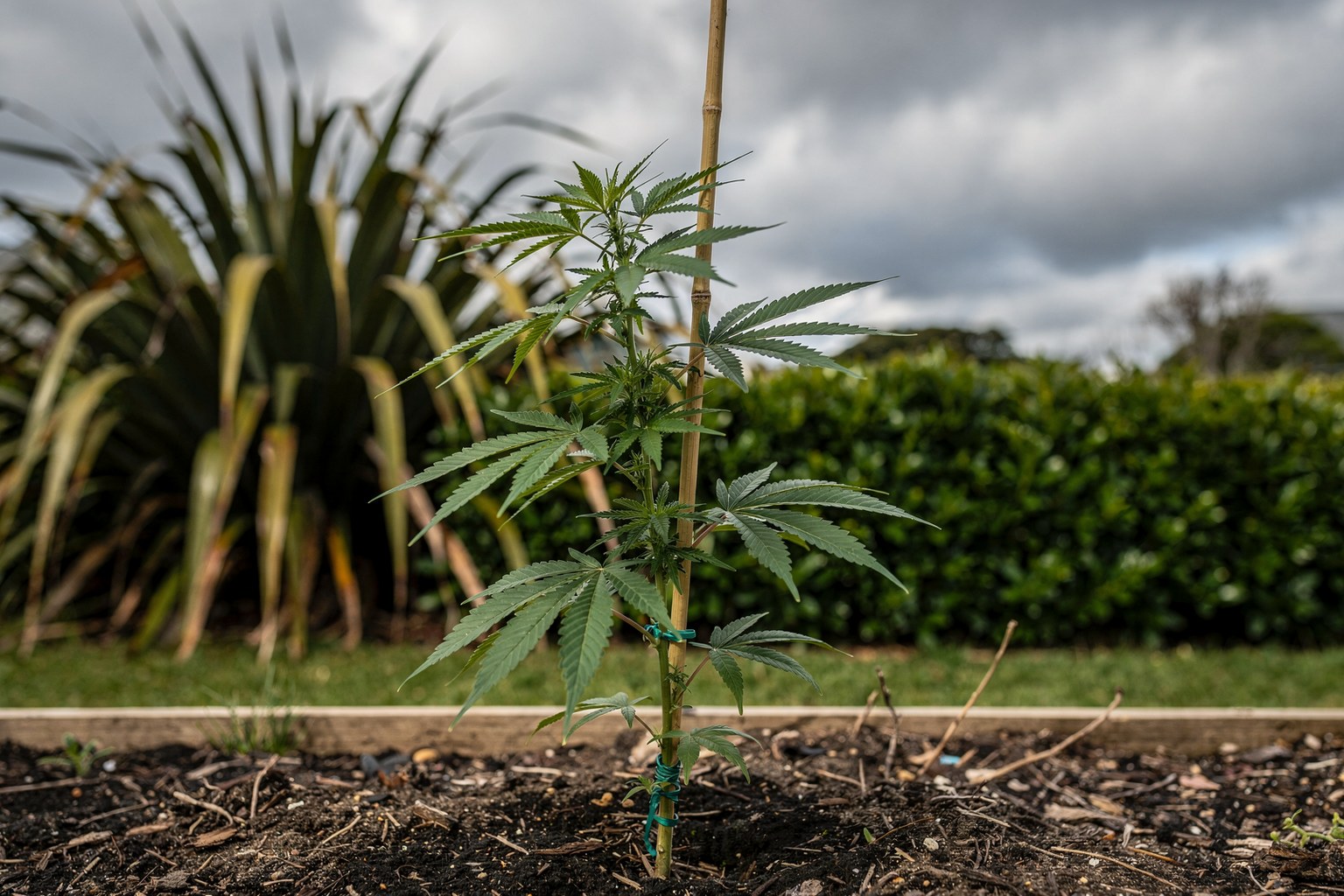
Wind damage in cannabis plants ranges from torn leaves and dry, scorched margins to bent or split stems. In New Zealand, where westerly fronts, nor’westers and coastal gusts are part of normal spring weather, shelter and simple support do most of the work. A plant that is sheltered from the strongest gusts and loosely tied to a stake usually recovers well from moderate wind.
By the Kiwi Seed Bank grow team.
Key takeaways
- Wind is a normal stress: Gentle movement strengthens stems, but repeated strong gusts tear leaves and dry out tissue.
- Location matters most: A site out of the prevailing wind is worth more than any amount of repair after a storm.
- Support early: A stake placed while the plant is small avoids root disturbance later.
- Use soft ties: Wide, flexible ties hold stems without cutting into the bark as the plant thickens.
- Be patient after damage: Bent stems often straighten and split stems can callus when they are supported quickly.
Why wind matters for cannabis plants in New Zealand
New Zealand sits in the path of the westerly wind belt that circles the Southern Ocean. Weather systems move quickly across the country, and spring is often the windiest part of the year. Days of calm, warm sunshine can be followed by a front that brings strong gusts, cooler air and rain within a few hours. For an outdoor plant, this means stress arrives suddenly rather than gradually.
Some wind is useful. Plants that sway in a breeze develop thicker, more flexible stems, and moving air dries leaf surfaces after rain, which reduces the time that fungal spores have to settle. Growers who raise seedlings in completely still air sometimes notice that the plants become tall and thin, with stems that struggle once they are moved outdoors. A light, steady breeze is therefore part of healthy development.
Problems begin when gusts become strong enough to bend the main stem repeatedly, rip larger fan leaves or strip moisture from the foliage faster than the roots can replace it. Young plants with small root systems are especially vulnerable, as are tall plants carrying heavy flowers late in the season. A plant in a container can also tip over completely, which damages branches and disturbs the root ball.
Recognising wind stress, windburn and snapped stems
Wind damage is easiest to manage when it is recognised early. The signs fall into a few broad groups.
Leaf damage
Torn and shredded leaves are the most visible symptom. The edges of fan leaves can split along the veins and flap loosely, while smaller leaves become creased or folded. Windburn appears as dry, papery margins that turn pale tan or brown, often on the side of the plant facing the prevailing wind. It can look similar to nutrient problems or heat stress, but its one-sided pattern is a useful clue.
Stem and branch damage
Bent stems lean away from the wind and may show a crease or a kink at the point of strain. Split stems have a visible crack, sometimes with pale inner tissue exposed. Snapped branches hang downwards and wilt quickly if the break is complete. In heavier plants, the main stem may lean at the base, which suggests that the roots have shifted in the soil.
Whole-plant stress
A plant that has spent a day in drying wind may droop in the evening even when the soil is moist. This happens because water leaves the leaves faster than the roots can supply it. Most plants recover overnight. Persistent drooping after calm weather returns is more likely to point to root damage or a different problem, such as the waterlogging described in our guide to watering cannabis in a wet climate.
Regional wind patterns from Northland to Southland
Wind exposure varies a great deal across the country, and our overview of New Zealand’s climate regions explains why north, south, east and west differ. A few patterns are especially relevant to outdoor plants.
- Wellington and the Cook Strait: The strait funnels westerly and southerly winds, and gusts are frequent throughout the year. Sites in the lower North Island and around Marlborough often need permanent shelter.
- Canterbury and the eastern South Island: Hot, dry nor’westers descend from the Southern Alps and can scorch foliage within a day. Our article on growing cannabis in Canterbury covers these conditions in more detail.
- West Coast and Southland: Wind usually arrives together with rain, so the main concern is physical damage combined with wet foliage.
- Northland and Auckland: Subtropical lows and coastal sea breezes bring humid gusts, while small urban sections often create turbulent eddies between buildings.
- Central Otago and inland basins: Calm days are more common, but cold southerlies can arrive suddenly in spring.
Local landform often matters more than region. A hillside facing the prevailing wind, an open coastal paddock or the gap between two houses can be far windier than a garden only a few hundred metres away.
Shelter options for gardens, balconies and open sites
Shelter reduces wind speed without stopping airflow completely. Solid barriers such as fences and walls block wind but also create turbulence on the sheltered side, where gusts can tumble over the top and swirl back down. Permeable barriers work better because they slow the air while letting some of it pass through.
Living shelter
Hedges and shelter belts are common across rural New Zealand for exactly this reason. Flax, pittosporum, hebe and other dense shrubs filter the wind and provide a calmer area behind them. A shelter belt protects a distance several times its own height, so even a modest hedge can make a noticeable difference in a home garden.
Windbreak cloth and temporary screens
Windbreak cloth stretched between posts is quick to install and works well in vegetable gardens. A cloth that lets roughly half of the wind through reduces gust strength without creating the strong eddies that form behind solid fences. Temporary screens can be added in spring and removed later in the season when plants are larger and better anchored.
Balconies and courtyards
Balconies on upper floors are often windier than ground-level gardens. Placing containers against an inside wall, grouping them so they shelter one another and using heavier pots all reduce the risk of plants tipping over. Corners can act as wind traps, so it is worth watching how air moves around the space on a gusty day before deciding where plants should stand.
Stakes, ties and support structures explained
Support is the second line of defence after shelter. The aim is to hold the main stem steady while still allowing a little natural movement.
Single stakes
A single bamboo cane or timber stake placed beside the main stem is enough for most small and medium plants. It is best inserted early, while the plant is young, so that the stake does not pierce established roots. The stake should sit slightly on the windward side so that the plant leans against it rather than pulling away from it.
Soft ties
Garden ties made from soft plastic, strips of old fabric or purpose-made plant tape are gentler than wire or string. A loose figure-of-eight loop between the stem and the stake gives the stem room to thicken. Ties need checking every few weeks because a tie that was comfortable on a thin stem can cut into the bark of a thicker one.
Cages, trellis and netting
Larger plants benefit from a ring of stakes, a tomato cage or horizontal netting that supports several branches at once. Netting spreads the load of heavy flowers late in the season and keeps branches from swinging against each other in strong wind. Many growers in windy regions combine a central stake with a net or cage for the outer branches.
Containers
Pots catch the wind like a sail once plants become tall. Wider pots, heavier materials, a few bricks around the base or a tie from the stake to a fixed railing all help.
What recovery after a storm usually looks like
Most wind damage looks worse on the day it happens than it does a week later. Cannabis is a vigorous plant, and healthy specimens usually push new growth quickly once calm weather returns.
Bent and kinked stems
A stem that is bent but not broken can often be eased back into position and supported with a stake and soft tie. Over the following days, the plant usually strengthens the bent area, sometimes forming a thicker knuckle at the point of strain. This knuckle is a sign of repair rather than a problem.
Split stems
When a stem has cracked but is still attached, gardeners commonly bring the two sides back together and wrap them with plant tape, then support the branch so that it carries no weight. The tissue can callus over within a week or two. A clean, dry wrap helps keep moisture and debris out of the wound.
Torn and burned leaves
Damaged leaves still photosynthesise as long as they are mostly green. Leaves that are almost entirely brown or hanging by a thread contribute little and can be removed by hand to improve airflow. New leaves that grow after the storm show whether the plant has recovered.
Timing and seasonal context
Spring storms are usually less damaging than those that arrive late in the season, when plants carry dense flowers. A plant that is knocked about in October has months of growth ahead, while one damaged near harvest has less time to recover and greater exposure to moisture inside bruised flowers. This is why shelter and support are best organised early, before the plant has grown into its full size.
Regional notes
Gardeners in Wellington, Canterbury and coastal Otago often regard wind protection as permanent rather than seasonal. In sheltered northern valleys and inland basins, a stake and a check after each storm may be all that is needed. Whatever the region, watching how wind moves through a particular garden over a few weeks gives the most reliable guidance for where plants will be most comfortable.