

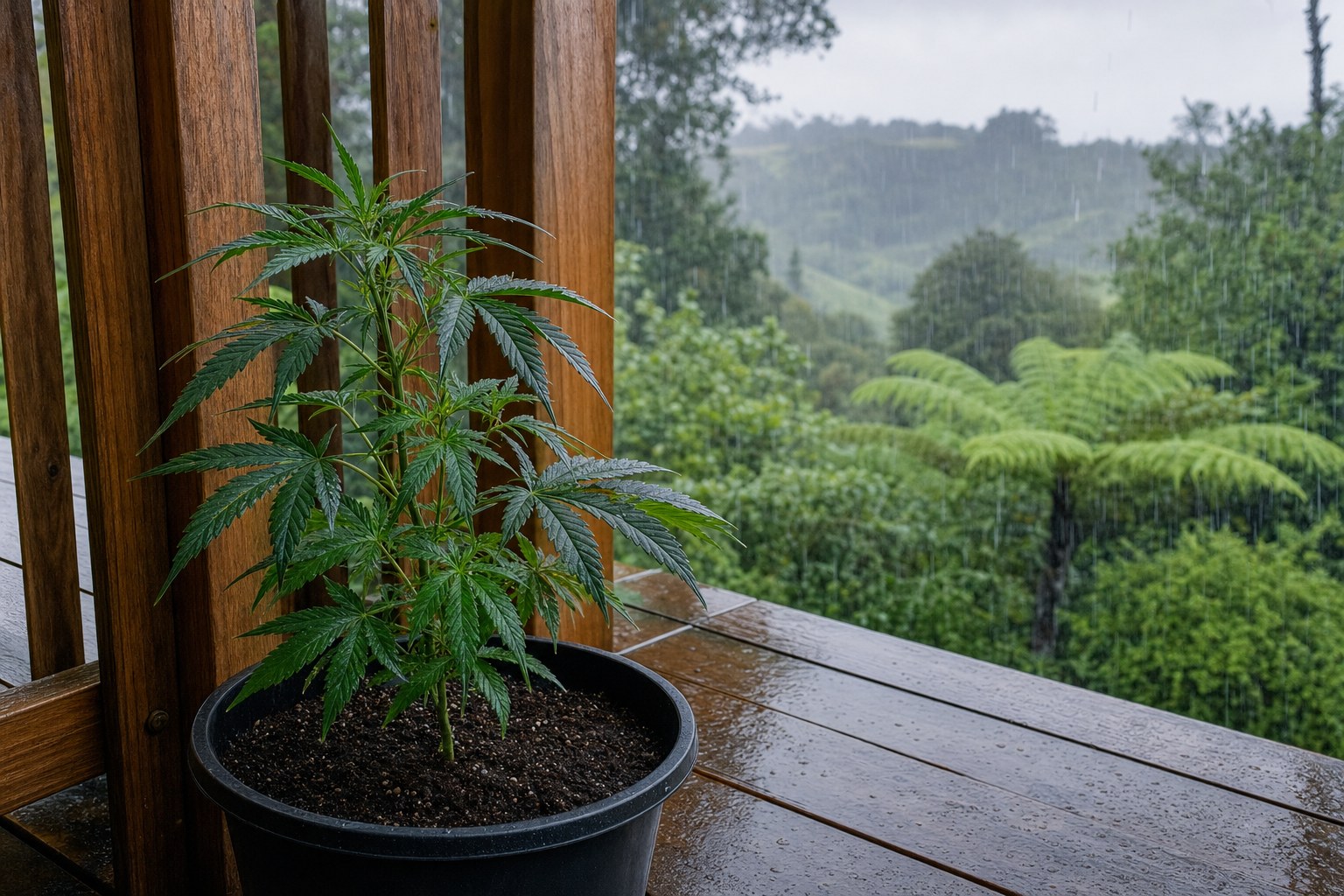
Overwatering cannabis in a wet New Zealand spring is best avoided by checking the growing medium before adding water, maintaining free drainage and keeping containers out of persistent rain. Water only when the root zone has partly dried, rather than following a fixed schedule. Observe pot weight, leaf posture, recent rainfall and local humidity together.
By the Kiwi Seed Bank grow team.
Key takeaways
- Check before watering: Test moisture below the surface and lift containers to assess their weight. A dry-looking top layer does not always mean the deeper root zone needs water.
- Prioritise drainage: Use containers with unobstructed drainage holes and a porous growing medium that releases surplus water.
- Account for rain: Natural rainfall is part of the watering total. Empty saucers and move portable plants under cover when prolonged rain is forecast.
- Read several signs together: Drooping leaves alone do not confirm excess water. Consider leaf texture, stem posture, medium moisture and pot weight.
- Adjust for local conditions: Coastal humidity, regional rainfall, wind exposure and cool spring temperatures can all change drying speed.
Overwatering cannabis in New Zealand’s wet spring conditions
New Zealand spring runs from September to November. During this period, longer daylight can encourage fresh growth, but soil and air temperatures may remain cool. Rain fronts, cloudy days and high overnight humidity can also slow evaporation. A container that dries within two days during settled weather might remain wet for four or five days after a cool rain event.
Overwatering cannabis does not simply mean pouring on a large volume at once. The central issue is how long the root zone stays saturated. One thorough watering followed by suitable drying can be less troublesome than repeated small additions that keep the medium continuously damp. Rainfall can create the same pattern when growers continue their usual watering routine without accounting for water received outdoors.
Fixed schedules are therefore unreliable in spring. A plant does not automatically require water every morning, every second day or on a particular weekday. Its demand changes with temperature, wind, sunlight, container size, plant size and the water-holding capacity of the medium. Check the plant and root zone each time instead.
For containers, insert a clean finger about 3 to 5 centimetres into the medium. If it feels cool and clearly damp, wait and check again later. Lifting the pot is another useful method. Learn how it feels shortly after drainage has finished and compare that with its noticeably lighter weight as the medium dries. Large containers may remain moist in the lower half even when the surface looks pale.
When water is needed, apply it evenly across the surface rather than concentrating it beside the stem. Allow surplus water to leave through the drainage holes, then empty any collection tray. Do not leave the base standing in runoff. If rain has already soaked the medium, skip the next planned watering and resume assessment only after drainage and partial drying.
How prolonged moisture affects cannabis root-zone oxygen
Roots need both moisture and oxygen. In a well-structured growing medium, pores contain a changing balance of air and water. Watering temporarily fills many of those spaces, after which gravity draws surplus water down and fresh air returns. Problems arise when compacted material, blocked drainage or repeated rain leaves the pore spaces filled with water for too long.
Low oxygen availability can restrict normal root activity. The plant may then struggle to maintain balanced water and nutrient movement even though the container contains plenty of moisture. This explains why a saturated plant can droop in a way that resembles a dry one. Adding more water in response can extend the problem.
Container choice has a major influence. A pot should have enough drainage openings for water to leave freely, and those openings must remain clear. Setting the container directly on compacted soil, a flat deck or a full saucer can obstruct flow. Pot feet or a stable raised surface can create a gap beneath the base, provided the container remains secure in spring winds.
The growing medium matters as well. Fine, compressed material generally holds water longer than a loose, porous blend. Avoid pressing the medium firmly into the pot during filling. Compression removes air spaces and can create uneven wet zones. If an established container drains very slowly, focus on shelter, airflow and careful watering rather than repeatedly disturbing active roots.
Good drainage does not mean forcing the medium to become completely dry throughout. Extreme drying can stress fine roots and make some media difficult to wet evenly again. The practical aim is a cycle: thorough watering when required, free drainage, then enough time for air to return before the next irrigation.
Botanical signs associated with persistently saturated growing media
Plants in persistently wet media often show a combination of downward leaf posture, reduced vigour and slow drying. Leaves may hang while remaining relatively firm or thick. In contrast, leaves on a very dry plant often feel thinner and less supported, and the container is usually light. These are tendencies rather than absolute rules, so inspect several indicators.
Start with the medium. Is it still damp several centimetres down? Is the pot heavy compared with its normal dry weight? Has it rained recently, or has water collected beneath the container? If these observations align with drooping growth, excess moisture is more plausible than thirst.
Other associated signs can include yellowing on older leaves, slowed new growth or a generally dull appearance. These symptoms are not exclusive to overwatering cannabis. Cool nights, low light, abrupt exposure changes, root restriction and nutrient imbalance can produce overlapping patterns. Avoid making a major change based on one leaf or one cool morning.
If saturation appears likely, pause irrigation and allow gravity, airflow and plant uptake to lower moisture levels. Empty standing runoff and shelter the pot from additional rain without enclosing it in stagnant air. Do not try to compensate by adding fertiliser. Extra dissolved salts do not restore root-zone oxygen and may add another source of stress.
Monitor the plant over several days. Recovery in spring can look gradual because cool, cloudy conditions keep plant activity and evaporation modest. Focus on whether new growth appears steadier and whether the medium begins returning to a normal wet-to-dry rhythm. Damaged older leaves may not regain their original appearance, so fresh growth is often the clearer reference point.
Rainfall, humidity and drainage across New Zealand climate regions
New Zealand conditions vary sharply over short distances. Regional rainfall patterns are useful, but the exact site can matter just as much. Hills, coastal exposure, buildings, fences and prevailing winds all influence how much rain reaches a plant and how quickly the container dries afterwards. Our guide to New Zealand climate regions provides broader context for these local differences.
Regional notes for spring
- Northland and Auckland: Mild temperatures can support active growth, while frequent showers and humid nights may keep containers moist. Emphasise airflow and direct inspection rather than assuming warmth guarantees rapid drying.
- Bay of Plenty, Waikato and central North Island: Sheltered inland sites can retain cool morning moisture, while exposed areas may dry quickly in wind. Reassess after each weather change instead of carrying yesterday’s watering decision forward.
- Taranaki and western districts: Rain-bearing westerly systems can deliver repeated wet periods. Covered positions and raised containers are useful where rain arrives faster than the medium can drain.
- Hawke’s Bay, Gisborne, Wairarapa and eastern districts: Settled spells can be comparatively dry, but a wet front can still saturate a container. Wind may dry the surface while deeper layers remain damp, making pot weight especially informative.
- Wellington and exposed coastal areas: Strong wind can increase water loss while also making shelters unstable. Secure pots and covers carefully, and check moisture rather than assuming every windy day requires irrigation.
- Nelson, Tasman, Marlborough and Canterbury: Sunny intervals can alternate with cold rain and cool nights. Containers may dry unevenly, particularly when one side receives more sun. Rotate portable pots only when doing so does not compromise stability.
- West Coast and wetter South Island districts: Repeated rainfall makes free drainage and overhead shelter particularly important. Maintain open sides around covered plants so humid air does not become trapped.
- Otago, Southland and cooler inland locations: Low spring temperatures can greatly slow water use. Allow longer intervals between checks, and remember that large pots may stay wet deep inside long after the surface changes colour.
A simple spring record can clarify local patterns. Note each watering, meaningful rainfall, pot-weight observation and visible change in the plant. After two or three weeks, the record may reveal that drying takes two days in sunny wind but five days during cloudy, humid weather. This is more useful than adopting a universal timetable.
Why sheltered sites can still retain moisture after rain
A porch, eave or greenhouse roof can keep direct rain off foliage while the root zone remains wet. Wind-driven rain may enter from the side, runoff can splash into low pots, and a container may already be saturated from an earlier event. Shelter also reduces wind and direct sunlight, which may slow evaporation considerably.
Covered spaces need ventilation. A tightly enclosed corner can hold humid air around the plant and growing medium. Leave room between containers, walls and surrounding vegetation. Avoid wrapping the pot or soil surface with non-breathable material, as this can trap moisture and make inspection difficult.
Check where water travels during a downpour. Roof runoff may fall just beyond an eave and bounce into the container. Water can also pool on uneven paving beneath a pot. Position the plant where drainage water moves away from the base, and make sure the chosen surface can safely support the full weight of a wet container.
Mulch deserves attention in a rainy season. A thick layer reduces evaporation and hides the condition of the medium. Where persistent moisture is already an issue, temporarily drawing mulch back from the surface can make checks easier and allow somewhat faster drying. Keep loose organic material away from the main stem.
Distinguishing excess moisture from normal spring plant variation
Spring plants naturally change posture through the day. Leaves may sit lower during cool early mornings and become more upright as light and temperature rise. A brief change after transplanting, strong wind or a sudden move into brighter light can also occur without persistent saturation. Observe timing before drawing conclusions.
Use a short diagnostic sequence. First, check moisture 3 to 5 centimetres below the surface. Second, lift the container if practical and safe. Third, examine whether drainage holes are open and whether runoff is trapped. Fourth, review rain, cloud, wind and temperature over the previous several days. Finally, compare older symptoms with the appearance of new growth.
If the medium is damp, the pot is heavy and drainage has been slow, wait. If the medium is dry at depth, the pot is light and leaves feel soft rather than firm, water may be required. When evidence is mixed, recheck later instead of reacting immediately. A few extra hours of observation can be more informative than another watering.
The most reliable approach to overwatering cannabis is not a single gadget or calendar. It is a repeatable habit of checking root-zone moisture, respecting recent rainfall and maintaining drainage. In New Zealand’s changeable spring, that responsive approach helps containers move through a healthy wet-to-dry cycle without being kept continuously saturated.