

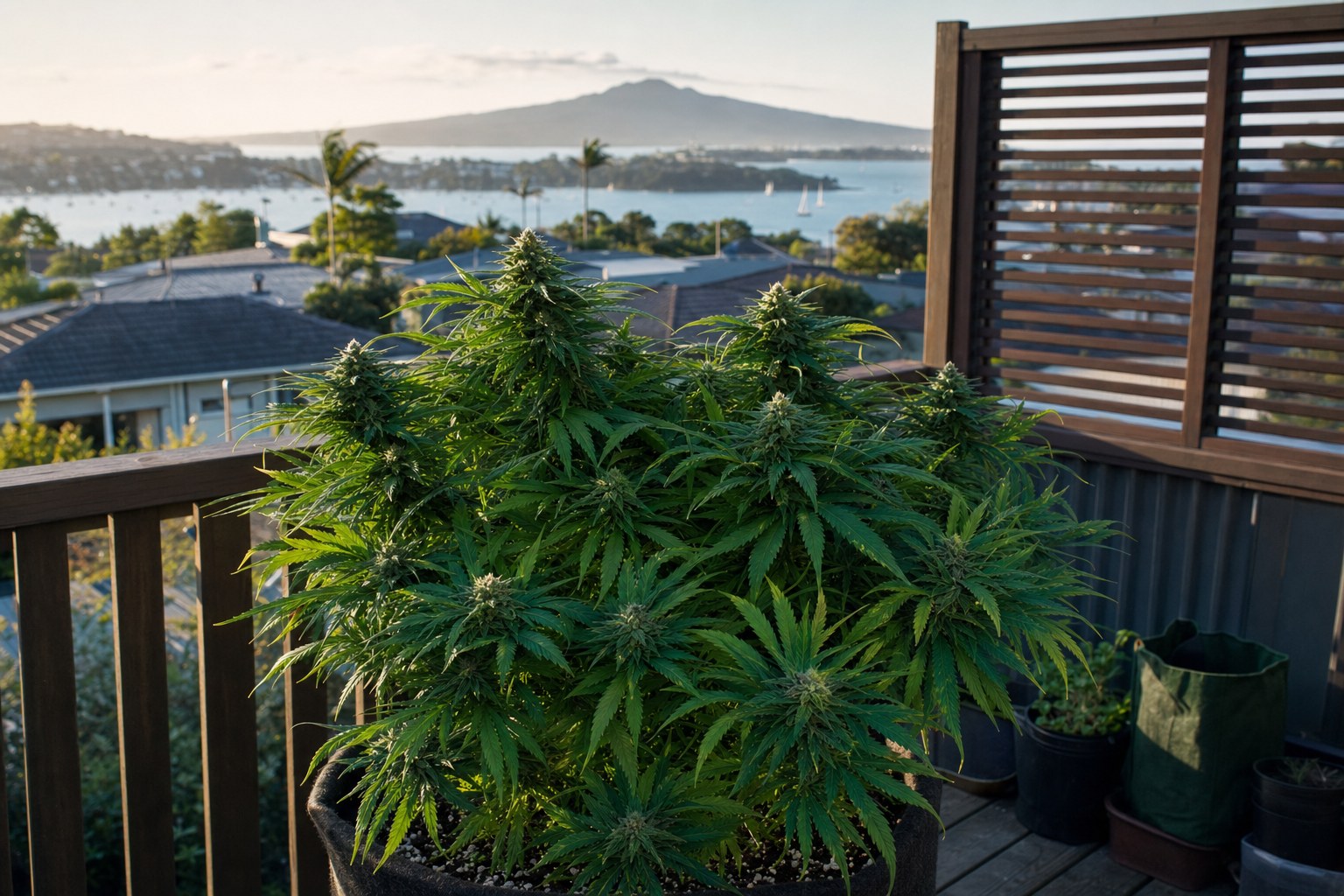
Growing weed in Auckland is generally unlawful without the appropriate authorisation under New Zealand law. If you are legally permitted to cultivate cannabis, Auckland’s humidity, sudden spring rain, coastal wind and compact sections make airflow and site selection especially important. Check current rules first, then assess whether your space can support responsible, low-impact cultivation.
Key takeaways
- Personal cannabis cultivation remains unlawful in New Zealand unless it takes place under a relevant legal authority.
- Auckland’s mild, humid climate can leave foliage and growing surfaces damp for extended periods.
- Good airflow, sensible spacing and morning sun are valuable on compact suburban properties.
- Decks, balconies and courtyards may have weight, drainage, wind, privacy and body-corporate limitations.
- Rain covers must remain open at the sides so warm, moist air can escape.
- Neighbour impact matters. Avoid runoff, intrusive lighting, obstructed access and strong odour near boundaries.
Growing weed in Auckland: start with New Zealand law
New Zealand law is the first consideration for anyone researching cannabis cultivation. Possessing, importing, germinating or cultivating cannabis seeds may carry legal consequences unless the activity is covered by a valid licence or another applicable authority. The rules for industrial hemp, research and regulated cannabis production are distinct, and each pathway has its own conditions.
This article provides general climate and site-planning information for people who are legally authorised to cultivate. It is not legal advice and does not imply that cultivation is permitted at a private Auckland home. Rules can change, and circumstances such as tenancy agreements, body-corporate requirements and property covenants may add further restrictions.
Check current rules before buying seeds or planning a grow
Confirm the current position through official New Zealand government channels before obtaining seeds, preparing a site or moving cultivation equipment onto a property. Do not assume that overseas rules, online discussions or a change in public debate applies in Auckland. Importation, possession and cultivation are separate legal questions, so permission relating to one activity may not cover another.
People operating under a formal licence should read every relevant condition, including approved locations, plant material, record keeping, storage, access and disposal requirements. If any point is unclear, obtain qualified legal guidance or clarification from the responsible authority before acting. A cultivation plan should follow the exact scope of the authority rather than relying on a broad interpretation.
Why privacy does not change your legal responsibilities
A screened courtyard, fenced section or apartment balcony may feel private, but privacy does not alter legal responsibilities. Nor does land ownership automatically permit cannabis cultivation. Tenants must also consider their tenancy agreement, while apartment residents may be subject to body-corporate rules covering plants, water, loads, alterations and the use of shared areas.
Privacy measures should never obstruct paths, emergency access, ventilation or sightlines needed for safe movement around a property. Avoid structures that shed water onto neighbouring land or catch strong wind. Any lawful activity should be planned with household members, neighbours and property boundaries in mind, rather than assuming that visual screening resolves every issue.
Auckland’s spring growing conditions
Auckland has a relatively mild maritime climate. Spring usually brings increasing daylight and warming soil, but conditions can shift quickly. A bright morning may be followed by showers, cloud or gusty winds. The city’s two harbours, varied elevation and dense urban form create local differences that are significant even across a short distance.
For authorised outdoor cultivation, calendar dates are less informative than repeated observations. Note where sunlight falls, how long leaves remain wet after rain, which corners receive moving air and where water gathers. A site that appears bright at midday may be shaded through the morning, leaving moisture on foliage much longer than expected.
Humidity, harbour haze and changeable rainfall
Humidity is often the defining Auckland challenge. Moist air can linger overnight, while spring showers repeatedly wet foliage and containers. Harbour haze and low cloud may also reduce drying conditions. When plants are crowded against fences or walls, these patterns can create a still pocket in which leaves remain damp.
Look for a position that receives useful morning light and steady, gentle air movement. Morning sun helps surfaces dry after dew or overnight rain, while natural airflow carries humid air away from the canopy. Avoid tightly enclosed corners, especially those beside damp retaining walls, dense hedges or areas where roof runoff splashes onto plants.
Rainfall totals alone do not describe moisture pressure. Several light showers separated by cloudy intervals may keep a site wetter than one heavier downpour followed by sun and wind. Regular observation is therefore more useful than reacting only to a weather app’s daily rain figure.
Mild temperatures, wind and exposed sections
Auckland’s spring temperatures are generally moderate, but exposed sites can still experience cool nights and abrupt changes. Coastal suburbs may receive salt-bearing winds, while elevated areas can face strong gusts. Narrow spaces between buildings may accelerate wind, creating a tunnel effect that bends stems, shifts containers and dries one side of a plant faster than the other.
Wind exposure should be moderated without sealing the site. A permeable windbreak allows some air through and creates less turbulence than a solid barrier. Any screen or freestanding structure must be suitable for the location and properly positioned so it cannot topple, block shared access or place extra strain on balcony fittings.
Reading microclimates across a compact property
Even a small Auckland section can contain several microclimates. A north-facing deck may warm rapidly, a south-facing wall may remain cool, and a paved courtyard may hold heat into the evening. Raised timber decks often dry faster than ground-level corners, while spaces below eaves can receive less rain but also less useful light.
Map the property over several clear and cloudy days. Record direct sun in the morning, around midday and late afternoon. After rain, check which surfaces dry first and which remain slick or shaded. Observe wind direction at plant height rather than relying on conditions above the roofline. This simple site audit can reveal whether a proposed area is genuinely suitable.
Planning for humidity on a small Auckland section
Small spaces reward restraint. Filling every available corner can reduce airflow, complicate inspection and make routine property access difficult. For any authorised cultivation, choose a manageable footprint and allow clear space around plants, walls and railings. The objective is not maximum occupancy; it is a site that remains orderly, observable and responsive to changing weather.
Prioritise airflow and avoid crowded spaces
Foliage should not be pressed against fences, windows or neighbouring plants. Contact points stay damp and are difficult to inspect. Keep access routes open so all sides can be viewed without pushing through growth. Remove unrelated clutter, empty containers and materials that hold water around the growing area.
Natural airflow is usually preferable outdoors. Where licensed operations use powered equipment, it must be appropriate for outdoor conditions and installed in line with electrical and building requirements. Household extension leads, exposed connections and devices placed near runoff create avoidable hazards and should not be improvised as a response to humidity.
Frequent visual checks are useful after still nights and rainy periods. Look for persistent condensation, damaged leaves, blocked drainage and debris gathering in dense areas. Early observation allows the environment to be adjusted before damp conditions become established.
Balconies, decks and courtyards: practical limitations
Balconies can receive good light but may also face strong wind, reflected heat and strict load limits. Containers, wet growing media and stored water become heavy. Do not guess what a balcony can support, and do not attach screens, frames or covers to rails without approval. Drainage must not drip onto pedestrians, neighbouring balconies or shared property.
Timber decks provide elevation and airflow, yet runoff can stain surfaces or collect beneath pots. Use stable supports suited to the deck and keep drainage routes clear. Avoid placing heavy containers where they obstruct doors, steps or emergency exits. On sloping sections, confirm that each container sits level and cannot move during gusts.
Courtyards are often sheltered but can become humid wells between walls. Pale masonry may reflect useful light, while dark paving can become unexpectedly warm on sunny afternoons. Measure conditions at the intended plant position. A reading taken in an open doorway may not represent the still, warm air at the rear of an enclosed courtyard.
Managing rain exposure without trapping moisture
A simple overhead rain cover may reduce direct saturation for an authorised crop, but enclosing the sides can trap humidity. Covers should have ample open space for air exchange and enough pitch for water to run off predictably. Sagging material collects water, adds weight and may release a sudden sheet of runoff during wind.
Place any lawful structure so discharge stays within suitable drainage areas and away from foundations, paths and neighbouring property. Local building, tenancy or body-corporate approval may apply. Transparent covers can also raise daytime temperatures quickly, so shade, condensation and airflow need observation whenever the weather changes.
Containers require unobstructed drainage, but excess runoff should be managed responsibly. Do not allow water or growing media to enter stormwater drains. Saucers can protect surfaces, although standing water should not be left to become stagnant. The best arrangement balances drainage with clean, controlled collection.
Choosing a suitable site without creating neighbourhood pressure points
A suitable site must work for the entire property, not only the plant. Consider nearby windows, shared fences, washing lines, children’s play areas, pets and regular maintenance access. Lawful cultivation should not create odour, glare, noise, water discharge or physical obstruction for other people.
Avoid bright lighting visible beyond the property or into neighbouring rooms. Outdoor electrical installations may require professional input and must meet applicable standards. Likewise, do not place containers where falling material could leave the site, or where growth may extend across a boundary.
Open communication may be appropriate for ordinary property matters such as drainage or temporary building work, but it does not replace legal authority. If a site cannot meet legal, structural and neighbourhood requirements, the responsible decision is not to use it.
Auckland spring grow calendar for authorised cultivation
Early spring: September
September is a planning and observation month. Day length increases, but nights can remain cool and wet. Confirm all legal permissions before any cultivation activity. Audit sunlight, wind and drainage, inspect decks or courtyards, and watch how the proposed site behaves through several weather systems. Delay outdoor placement if conditions or approvals are unsuitable.
Mid-spring: October
October often brings stronger sun alongside changeable rain. Recheck the site as the sun angle shifts and nearby trees produce new growth. Ensure access remains clear and watch for repeated leaf wetness in sheltered corners. Wind can strengthen quickly, so assess the stability of containers and approved structures after each front.
Late spring: November
By November, warmer days can increase growth and water use, yet humid nights remain common. Continue monitoring morning moisture, airflow and runoff. Check that expanding foliage has not narrowed spacing or reached walls and railings. Review cover ventilation before warmer summer conditions arrive, and remove unnecessary clutter from the area.
Final Auckland planning checklist
- Confirm authority: Verify current New Zealand rules and the exact scope of any licence before buying seeds or planning cultivation.
- Observe the site: Record sun, shade, rain exposure, wind and drying time across several spring days.
- Allow airflow: Select an open position and avoid packing foliage against walls, fences or other plants.
- Check structures: Confirm deck loads, balcony rules, drainage routes and approval requirements.
- Plan for rain: Keep any approved cover open-sided and direct runoff to an appropriate area.
- Limit impact: Avoid intrusive light, noise, odour, blocked access and discharge beyond the property.
- Review regularly: Auckland weather changes quickly, so reassess the site after rain, wind and seasonal growth.
The Kiwi Seed Bank grow team’s central advice is simple: begin with the law, then design around Auckland’s moisture and space limitations. A bright corner is not automatically a suitable site. Responsible planning considers airflow, drainage, structural limits, neighbours and the whole property.