

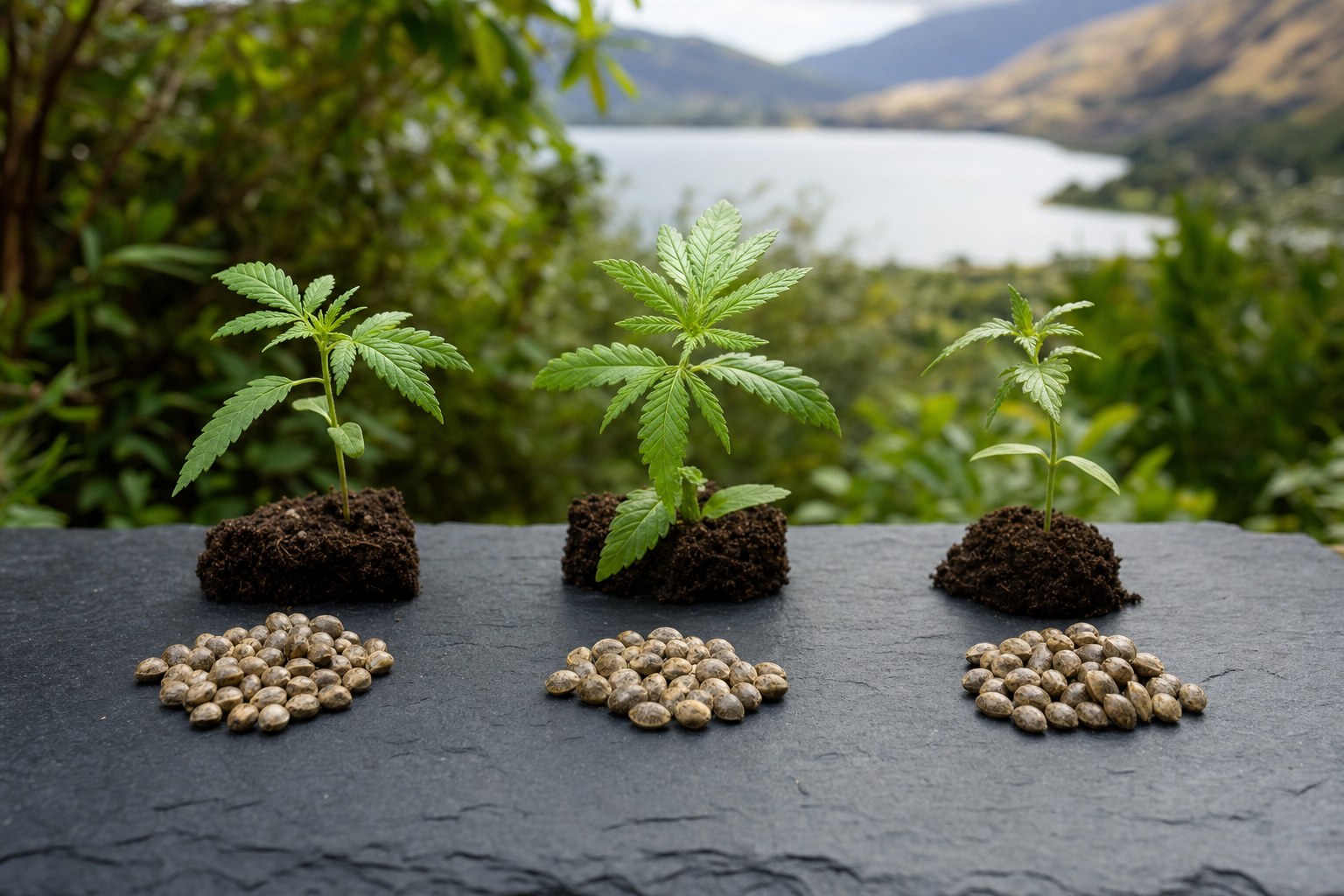
For most Kiwi home growers comparing feminised vs autoflower in NZ, feminised seeds suit a planned spring-to-autumn grow, while autoflowers suit short summers, compact spaces or quick cycles. Regular seeds are generally best for experienced growers interested in selecting males, preserving genetics or making crosses. Your setting, timing and goals matter more than any single label.
Key takeaways
- Feminised seeds are selected to produce female plants in the great majority of cases, making space planning straightforward.
- Autoflower seeds begin flowering mainly according to age rather than changing daylight, so they can fit short outdoor windows.
- Regular seeds can produce female or male plants and are useful for growers who want broader selection or breeding options.
- New Zealand’s latitude, local wind, rainfall, frost dates and autumn humidity should shape the decision.
- No seed type removes the need for suitable light, healthy roots, airflow, observation and realistic timing.
Feminised, autoflower and regular seeds at a glance
The three labels describe different reproductive or flowering characteristics. They do not indicate one universal level of quality, strength or difficulty. Genetics, seed condition and the grower’s environment remain important within every category.
Feminised seeds are produced to give growers a very high likelihood of female plants. Since female plants are usually the focus of flower production, this allows a grower to use pots, soil, lighting and available space more efficiently. Most feminised varieties are photoperiod plants, meaning longer uninterrupted nights prompt flowering.
Autoflower seeds carry genetics that allow flowering to begin largely according to plant age. Many autoflower options are also feminised, so “autoflower” and “feminised” are not opposites. One term describes flowering behaviour; the other describes the expected sex of the plants. An autoflower can therefore be both autoflowering and feminised.
Regular seeds may grow into female or male plants. They give growers access to both sexes and can support selection, seed making and longer-term genetic projects. However, anyone seeking only female flowers must identify and separate unwanted males before pollen is released.
Before acquiring or germinating any seeds, check the rules that apply to your location and circumstances. Our overview of cannabis seed law in New Zealand provides general context, but requirements can change and individual situations vary.
How feminised seeds differ
Feminised seeds simplify one of the biggest variables in an ordinary photoperiod grow: plant sex. A grower filling a greenhouse, sheltered garden area or indoor canopy can estimate how many mature female plants will occupy the available space without expecting roughly half to be males.
This is particularly useful when each container, light position or sunny garden site matters. It can also reduce wasted weeks spent supporting plants that do not match the grower’s objective. Even so, feminised does not mean absolutely certain. Plants should still be inspected as flowering begins, especially after major environmental stress.
Most feminised photoperiod plants offer flexibility during vegetative growth. Indoors, the grower controls when the light schedule changes. Outdoors, plants usually grow through spring and summer before naturally flowering as nights lengthen. This longer vegetative window permits topping, gentle training and recovery from modest setbacks, provided the season has enough time left.
The trade-off is that outdoor timing depends on daylight and the variety’s flowering speed. A late-finishing plant may run into cool nights, heavy dew or wet autumn weather in parts of New Zealand. Greenhouse shelter and good airflow may help, but they cannot make an unsuitable seasonal window ideal.
Feminised photoperiod seeds commonly suit growers who have a reliable site, want larger individual plants, can plan across several months and do not need male plants. They are also approachable for beginners because the vegetative period provides time to learn plant responses. New growers can explore our guide to the easiest strains for beginners in NZ when comparing practical traits.
How autoflower seeds differ
Autoflowers move from early growth into flowering according to their internal timeline. They do not need a seasonal change in day length or a deliberate indoor light switch to begin that transition. Many complete their full cycle faster than photoperiod varieties, although the exact pace varies by genetics and conditions.
For New Zealand growers, that speed can be valuable. A short cycle may fit between late spring cold and autumn rain, particularly in regions where the dependable warm period is limited. It may also allow more than one staggered outdoor run in warmer districts, if local conditions and applicable rules allow.
Compact growth makes many autoflowers suitable for balconies, small greenhouses and limited indoor areas. Compact does not mean invisible, and odour, security, neighbours, property rules and legal obligations still require consideration. Plant size also varies: modern autoflowers range from genuinely small plants to vigorous specimens needing meaningful space.
The main limitation is reduced recovery time. Because the flowering clock continues regardless of plant size, early root restriction, overwatering, transplant shock, cold weather or harsh training can affect the final structure. A photoperiod plant can often remain in vegetative growth while conditions improve; an autoflower generally cannot pause its schedule in the same way.
For that reason, an autoflower is not automatically easier. It is simpler in relation to light timing, but it rewards a steady start. Many growers sow into the final container, keep the root zone airy, avoid excessive feeding and use low-stress canopy shaping rather than major late changes.
Autoflowers can suit a grower who values speed, has a narrow weather window or wants a compact cycle. They can also be useful in southern or elevated settings, where selecting the warmest practical part of summer matters. See our guide to autoflowers for a short New Zealand summer for more seasonal detail.
How regular seeds differ
Regular seeds retain the possibility of both female and male plants. A small batch may not produce an exact half-and-half split, so planning must allow for variation. Growers seeking only female flowers generally start more seeds than the number of female plants they ultimately want, then identify sex as plants mature.
This requirement uses extra pots, growing medium, time and space during early development. Male plants must be recognised promptly if pollination is not wanted. Pollen is light and mobile, so separation needs to be deliberate rather than casual.
Why choose regular seeds? They provide access to male plants for controlled crosses and seed projects. They also allow experienced growers to assess a wider population, select individuals for structure, aroma, vigour or timing, and keep chosen plants for future work where their setup permits.
Regular seeds can also appeal to growers who value traditional selection practices. However, they demand observation and a clear plan. A first-time grower with room for only one or two plants may find feminised seeds more efficient. Someone building a genetic project may see the extra variation as the main advantage rather than a drawback.
Regular seeds are not inherently tougher, more natural in performance or better suited to New Zealand weather. Those traits belong to the underlying variety and individual plants. Likewise, feminised and autoflower seeds are not automatically fragile. Compare specific growth characteristics instead of relying on broad myths about each category.
Matching seed type to your New Zealand setting
New Zealand has no single cannabis-growing climate. Northland’s relatively mild conditions differ greatly from an exposed Wellington hillside, an inland Canterbury garden or a cool Southland section. Even nearby properties can have different frost pockets, wind exposure, sunlight and drainage.
In warm northern areas, growers may have a longer outdoor window for feminised photoperiod plants and greater scope for staggered autoflowers. Humid spells and autumn rainfall still make airflow and flowering time important. Dense plants placed against fences or crowded in still greenhouses can hold moisture around leaves and flowers.
Across Auckland, Waikato and the Bay of Plenty, warm growth can be vigorous, but variable rainfall means a sheltered and ventilated position is valuable. Both feminised photoperiods and autoflowers may fit. The choice often comes down to available months, desired plant size and whether the grower can watch autumn conditions closely.
Lower North Island locations can combine decent summer warmth with strong wind. Flexible branches may need support, while solid screens should not create stagnant pockets. Faster photoperiod varieties or summer-timed autoflowers can be practical where autumn exposure is a concern.
In the upper South Island, sunny districts may support productive outdoor growth, but local rainfall patterns vary sharply. Canterbury and other eastern areas can offer bright summers alongside dry winds, cool nights and sudden weather changes. Regular watering habits, mulch and stable containers may matter as much as seed category.
Otago, Southland, elevated areas and frost-prone inland sites usually have a shorter dependable window. Autoflowers timed for peak summer or early-finishing feminised photoperiod plants may be easier to align with conditions. A greenhouse can extend warmth and shelter plants from rain, but it needs ventilation because sunny days can raise temperatures quickly.
Planning around spring, summer and autumn
Spring: Observe the site before committing plants outdoors. Note the last local frosts, hours of direct sun, strong wind channels and how quickly soil or containers drain after rain. Spring weather is changeable, and one warm week does not mean cold nights have ended. Autoflowers are especially sensitive to a poor start because their internal schedule is already moving.
Summer: This is the main growth period across most regions. Photoperiod plants build structure under long days, while well-timed autoflowers can complete much of their cycle. Check containers frequently during hot, windy periods, but do not assume every drooping leaf means more water. Assess moisture below the surface first.
Autumn: Shorter days drive photoperiod flowering, while temperatures, dew and rainfall increasingly shape the finish. Inspect flowers and inner foliage regularly, maintain space between branches and respond to forecast weather. Late varieties may be comfortable in a warm northern site yet poorly matched to a cold southern one.
Work backwards from typical local conditions rather than relying only on a packet’s estimated number of weeks. Breeder-style time estimates are useful comparison points, not promises. Phenotype, plant health, latitude, weather and growing method can all shift the schedule. Our guide on when to plant cannabis in New Zealand explains the seasonal factors in more depth.
A practical Kiwi seed selection checklist
- Define the goal. For female flowers with efficient use of space, start with feminised options. For a short or compact cycle, compare feminised autoflowers. For male selection or crossing, consider regular seeds.
- Measure the real space. Account for mature height, container width, access paths, airflow and distance from lights or greenhouse roofing. Do not choose solely from a promotional height figure.
- Map the weather window. Use your own frost dates, summer temperatures and autumn rainfall patterns. A neighbour’s sheltered courtyard may perform differently from an exposed section nearby.
- Consider your available attention. Autoflowers reward consistency from the beginning. Photoperiod plants provide more time for shaping but may occupy the site for longer. Regular seeds add sex identification and separation.
- Look beyond seed category. Compare flowering speed, stretch, branch structure, humidity tolerance and expected size. These practical traits often matter more than the headline label.
- Plan plant numbers carefully. Feminised seeds make female numbers more predictable. Regular seeds require spare capacity. Autoflowers may be small, but crowding several plants can still reduce light and airflow.
- Choose a realistic skill level. Beginners often benefit from resilient feminised photoperiod genetics. A careful beginner can grow autoflowers successfully, but should keep the setup simple and avoid repeated changes.
- Confirm current obligations. Rules can differ by activity and may change. Check authoritative New Zealand information relevant to your circumstances before acting.
The best seed type is the one that fits your actual season, space and purpose. For many Kiwi growers, that means feminised photoperiod seeds for flexibility, autoflowers for speed, or regular seeds for deliberate selection and breeding work.
When comparing feminised vs autoflower in NZ, avoid treating the decision as a contest with one permanent winner. Start with your local climate and practical limits, then select a category and variety whose timing matches them. Sound planning at the seed stage makes the rest of the cultivation calendar clearer.