

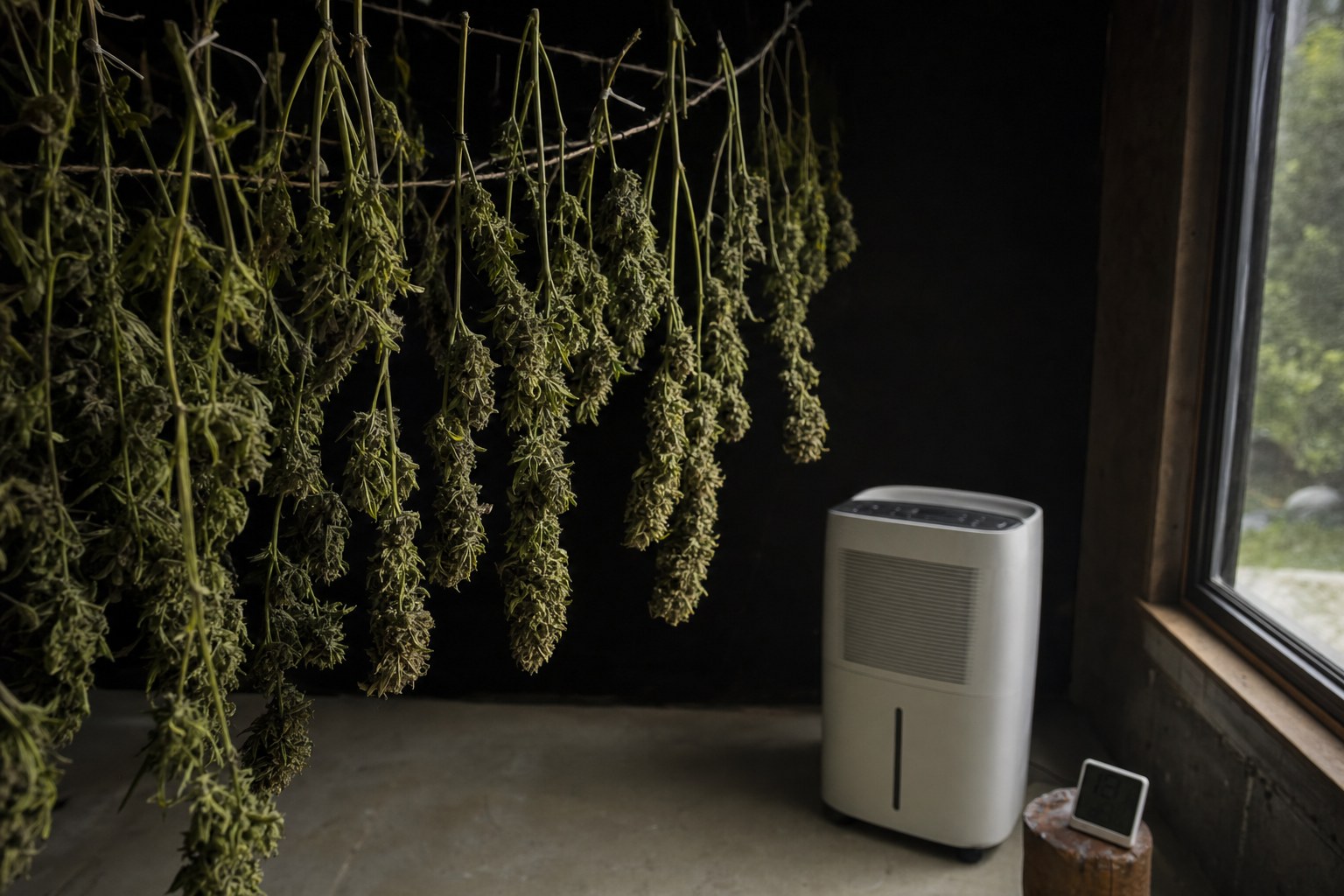
To dry harvested cannabis in New Zealand’s humid autumn, use a dark, clean space with gentle air exchange, stable temperature and closely monitored relative humidity. Hang branches with room between them, avoid directing fans at flowers, inspect daily for mould, and move evenly dried material into clean containers for gradual conditioning only when excess internal moisture has dispersed.
Key takeaways
- Autumn humidity can slow moisture loss and increase mould risk, particularly in northern and coastal regions.
- A hygrometer provides more reliable guidance than touch alone, but readings should be checked against the condition of the flowers.
- Gentle air exchange is preferable to strong airflow aimed directly at hanging branches.
- Drying too quickly may leave flowers brittle outside while moisture remains unevenly distributed.
- Inspect dense flowers every day and discard any material showing suspected mould.
- Check current New Zealand law before growing, harvesting, possessing or processing cannabis.
Drying and conditioning cannabis in New Zealand’s humid autumn conditions
New Zealand’s autumn weather can create a difficult transition from harvest to storage. Outdoor crops often finish as nights become cooler, rainfall becomes more frequent and relative humidity stays high for long periods. Even indoor rooms may take on damp outside air, especially in homes, sheds and garages with limited insulation.
The aim is steady, even moisture reduction rather than the fastest possible result. Flowers should lose enough water to become suitable for storage without having their outer surfaces made crisp by excessive heat or direct airflow. Once dry, gradual conditioning in containers allows remaining moisture to become more evenly distributed while aroma and texture settle.
Why autumn humidity needs careful monitoring
Relative humidity describes how much water vapour the air holds compared with its capacity at a given temperature. Cool air reaches high relative humidity more readily than warm air, which is one reason damp autumn nights can affect a drying room even when no rain enters it.
When surrounding air is already moisture-laden, water leaves plant material more slowly. Dense flowers, closely packed branches and still pockets of air may then remain damp for longer than expected. Conversely, running a heater or dehumidifier aggressively can dry exposed surfaces too fast. Monitoring helps growers make small adjustments rather than reacting after quality has declined.
Check current New Zealand law before handling cannabis
Cannabis activity is regulated in New Zealand, and rules can depend on authorisation and individual circumstances. Before growing, harvesting, possessing or processing cannabis, check the current requirements that apply to you. Nothing in this guide guarantees that an activity is lawful, and cultivation guidance should not be read as legal advice.
The difference between drying and post-dry conditioning
Drying and conditioning are connected stages, but they are not interchangeable. Drying removes most excess moisture from freshly harvested flowers in an open or ventilated environment. Conditioning begins only after flowers are dry enough to enter containers without creating persistently damp conditions.
Keeping the stages distinct matters in a humid climate. Sealing flowers too early traps moisture and raises mould risk. Leaving properly dried flowers exposed for too long may make them excessively brittle and reduce their aroma. A deliberate handover between stages supports more consistent results.
What happens during drying
Freshly harvested branches contain substantial water in stems, leaves and flowers. Once cut, that water begins moving towards the surface and into the surrounding air. The process is affected by flower density, branch size, room temperature, relative humidity, airflow and how much material occupies the space.
Small flowers and thin branches generally lose moisture sooner than large, compact flowers. Removing some broad leaves can improve spacing and reduce the volume of wet plant matter, while leaving branches intact may slow the process. There is no single timetable that suits every harvest, so physical inspection and environmental readings should guide decisions.
What post-dry conditioning is intended to achieve
Conditioning gives residual moisture time to redistribute through flowers after the initial drying stage. Material that appears dry on the outside can still hold more moisture internally. In a closed container, that moisture moves outwards, which may make flowers feel softer several hours later.
Containers are opened periodically during the early stage to exchange damp air and assess aroma, texture and humidity. If flowers become noticeably moist, clump together or produce an ammonia-like smell, they were enclosed too soon and should return to the drying space. Conditioning cannot make mouldy or poorly dried material safe.
Preparing a clean, controlled drying space
Choose a room or enclosure that can be kept dark, clean and separate from everyday dust, cooking vapour, smoke, pets and laundry moisture. A spare room or purpose-made enclosure is generally easier to manage than an exposed shed, provided access and local requirements are considered.
Clean surfaces and equipment before bringing in branches. Remove old plant debris, standing water, damp cardboard and unnecessary fabrics. Arrange hanging lines or racks so flowers do not touch walls, floors or one another. Leave access for inspection rather than filling every available gap.
Light, airflow and environmental monitoring
Keep the drying area dark apart from brief inspection periods. Strong light and heat can degrade colour and aroma, while sunlight passing through a window may create warm zones that are not obvious from a room-level reading.
Air should move through the room gently, carrying released moisture away without blasting the flowers. Aim a circulation fan towards a wall or open space rather than directly at branches. If using extraction, a low continuous setting or controlled intervals may be more suitable than abrupt, powerful air changes.
Place at least one digital hygrometer near flower height, away from a fan, heater or dehumidifier outlet. In a large room, use readings from different locations because corners and densely loaded sections can form humid microclimates. Record morning and evening conditions to identify patterns.
Using a hygrometer and dehumidifier cautiously
Many growers aim for a moderate room temperature and relative humidity around the upper-50s to low-60s during a gradual dry. These figures are practical reference points rather than guarantees. Equipment accuracy varies, flowers differ and the room may fluctuate when outside weather changes.
A dehumidifier can be useful during wet spells, but it should be introduced cautiously. Set it to maintain a stable range rather than chase the lowest reading. Keep its warm, dry outlet air away from hanging material, empty or drain collected water hygienically, and check whether operation is raising room temperature.
If the room becomes too dry, first reduce extraction, fan intensity or dehumidifier use. Avoid spraying water near harvested flowers. Adding uncontrolled moisture can create wet surfaces and uneven conditions. Slow adjustments followed by fresh readings are safer than repeatedly swinging between damp and dry extremes.
Reducing contamination and mould risks
Handle flowers with clean, dry hands or clean gloves and use sanitised tools. Do not hang visibly damaged or suspect material among healthy branches. Inspect the largest flowers by gently opening their outer structure and looking around the stem, where hidden moisture and decay may first become apparent.
Warning signs include grey or white fuzzy growth, unusual web-like fibres, brown internal areas, soft tissue and musty or ammonia-like odours. Natural resin can look crystalline, but it does not usually form spreading fuzzy patches. If you are uncertain whether growth is mould, isolate the material rather than placing it into storage.
Do not rely on trimming away a visible patch while keeping the surrounding flower. Contamination may extend beyond what can be seen. Discard suspect material and clean nearby tools and surfaces before handling the remainder of the harvest.
Assessing cannabis before and during drying
Start with appropriately harvested material
Bring harvested branches into the prepared space promptly, particularly after a damp outdoor morning. Flowers wet from rain, dew or washing need additional surface-drying attention before being placed close together. Gently remove obvious droplets and provide generous spacing without applying high heat.
Sort branches by size and density. Keeping similar pieces together makes inspection easier and reduces the chance that small flowers become overdry while thick branches remain damp. Remove dead leaves and any material showing rot, insect damage or soil contamination.
Check progress rather than following a fixed number of days
Drying may take roughly one to two weeks under moderate conditions, but New Zealand autumn weather can shorten or extend that window. A calendar estimate should never replace inspection. Check smell, surface feel, stem flexibility and room readings at least daily.
Early in the process, stems bend readily and flowers feel wet or spongy. As moisture decreases, small stems begin to give a light snap while thicker stems may still bend. Flowers should feel dry at the surface but retain some resilience when handled gently. If they crumble immediately, conditions may have been too dry or warm.
Test samples from several parts of the room. Material near an intake, door or dehumidifier may progress differently from material in a sheltered corner. Rotate positions only if this can be done cleanly and without damaging flowers.
Moving dried flowers into containers
Use clean, dry, airtight glass containers that are appropriately sized for the quantity. Avoid compressing flowers. Leaving some headspace allows gentle movement and makes it easier to inspect the contents. Label containers by plant or harvest section so any moisture issue can be traced rather than mixing the entire harvest.
During the first day, check the container after several hours. A small hygrometer placed inside can provide useful information, although compact meters should be checked for accuracy. If humidity climbs into the high 60s or flowers feel damp again, remove them and continue open drying before reassessing.
For material that remains stable, open containers briefly once or twice daily during the first week. Examine the flowers, smell the air and gently move the contents so pieces do not remain pressed together. As conditions stabilise, openings can become less frequent. Store containers in a cool, dark, stable place.
Autumn grow calendar and regional notes
March: prepare before the main outdoor harvest
Clean the drying space, test fans and hygrometers, and confirm that a dehumidifier can drain safely. Coastal humidity and late-summer rain may already affect early harvests. Avoid waiting until branches are cut before discovering that the room cannot exchange air or hold a stable environment.
April: monitor rapid weather changes
April often brings the main outdoor harvest period alongside cooler nights and unsettled fronts. Auckland, Northland, Bay of Plenty and other humid northern or coastal locations may require more active moisture management. Central and eastern districts can be drier, but cold nights may still push enclosed spaces towards high relative humidity.
May: account for cold rooms and southern conditions
In the lower South Island and elevated areas, unheated rooms may become very cold. A dehumidifier may work less efficiently at low temperatures, and condensation can form on windows or exterior walls. Gentle background warmth may help equipment operate consistently, but heaters must be positioned safely and must not blow onto flowers.
Across all regions, use the actual room readings rather than assumptions about the local climate. A well-insulated room in Dunedin may behave differently from a damp garage in the same suburb, just as an indoor Auckland space may remain stable despite wet weather outside.
Common problems and practical adjustments
Flowers are drying unevenly
Increase spacing, check for blocked airflow and compare readings across the room. Separate large branches from small ones and move only the slower material to a better-ventilated position. Do not compensate by directing a powerful fan at the entire harvest.
The room smells musty
Inspect every branch immediately, focusing on dense flowers and contact points. Increase clean air exchange and check for damp building materials, full dehumidifier tanks or condensation. Isolate and discard any suspect plant material. A fragrance product should never be used to mask unusual odours.
Flowers became crisp very quickly
Reduce direct airflow, heat or dehumidifier intensity. Check whether the hygrometer sits in a representative location. Flowers that are crisp outside may still hold internal moisture, so place a small sample in a monitored container for several hours. If humidity rises sharply, return it to a gentler drying environment.
Container humidity keeps rising
Remove the flowers from the container and spread them with space between pieces in the controlled drying room. Recheck after several hours rather than repeatedly opening and resealing damp material. Wash and fully dry any container that develops an unusual smell or visible moisture.
A patient approach suits New Zealand conditions
Successful post-harvest handling depends on cleanliness, observation and small environmental adjustments. Humid autumn air makes daily monitoring especially important, but aggressive heat and airflow can be just as damaging as excessive dampness. Prepare the room early, keep branches separated, compare readings with physical signs and never store material that remains moist or appears contaminated.
Conditions vary between regions, buildings and harvests, so regard target ranges and timelines as starting points. A stable, gradual process gives each batch the best opportunity to retain its natural colour, aroma and structure while reducing mould risk during storage.